
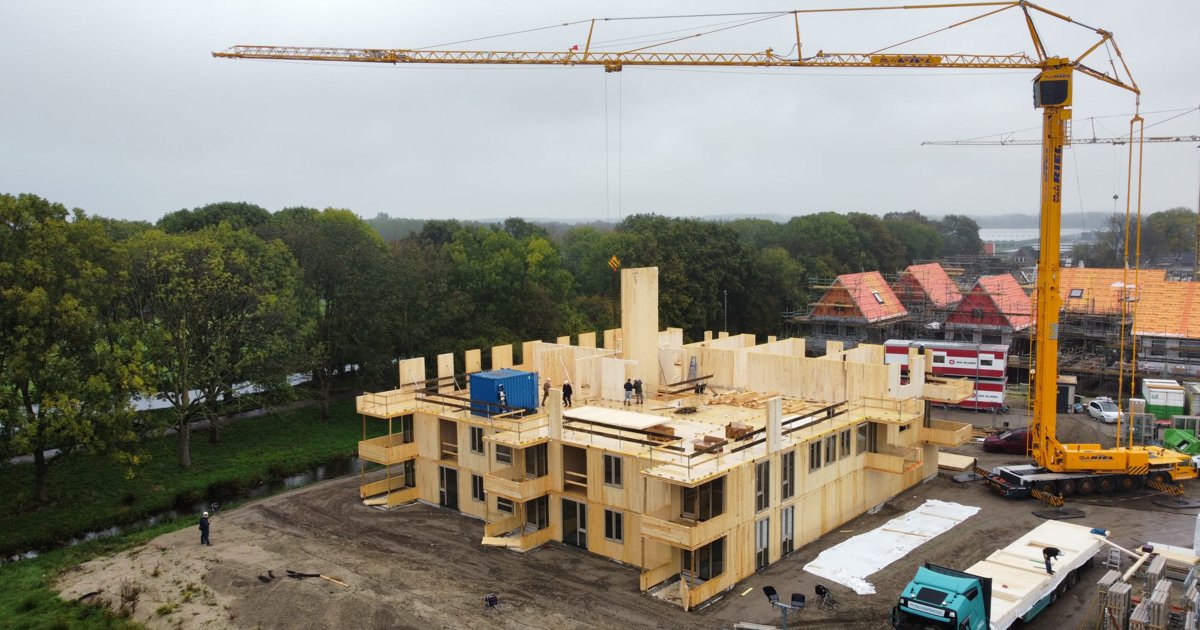
One of the biggest differences lies in the environmental impact.
Timber construction plays an active role in reducing CO₂ emissions:
- Wood stores CO₂ over the life of the building
- Biobased construction contributes to climate goals
- Fewer emissions in production and transport
Concrete, on the other hand:
- Has a high CO₂ emission from cement production
- Contributes significantly to embodied carbon in buildings
For projects with climate-adaptive design, circular construction in the Netherlands and Paris Proof ambitions, timber construction is often the logical choice.
Cost differences in practice
At the material level, concrete sometimes seems cheaper. But at the project level, a more nuanced picture emerges.
Timber construction can provide cost benefits by:
- lighter structures → lower foundation costs
- prefabrication → lower failure costs
- less transport and construction movements
Also read more about the <a href="/nl/kosten-houtbouw/">costs of timber construction</a> and how they develop per project phase.
When it comes to comprehensive considerations (Total Cost of Ownership), timber construction often appears to be competitive — especially within urban densification and complex inner-city projects.
Construction time and execution
Timber construction uses industrial prefabrication. This fundamentally changes the dynamics of the construction process.
Benefits:
- shorter construction time
- less construction site logistics
- higher build quality due to factory production
- faster delivery
For projects with tight deadlines or inner-city restrictions, timber construction offers a clear advantage.
In combination with an experienced <a href="/nl/clt-architect/">CLT architect in the Netherlands</a>, there is also more design freedom within standardized systems.
Legislation and regulations (MPG and CO₂ requirements)
The regulations in the Netherlands are increasingly focusing on sustainability. Think about:
- MPG (Environmental Performance Buildings)
- CO₂ reduction goals
- Building Paris Proof
- EU Taxonomy and ESG Criteria
Timber construction fits in seamlessly with this:
- lower MPG scores
- better positioning in tenders
- future-proof investments
For clients who are active in public projects or tenders, the choice of materials has therefore become strategic.
You can read more about this within <a href="/nl/duurzame-architect-aanbesteding/">sustainable architect tendering processes</a>.
When do you choose wood or concrete?
The right choice always depends on the project, the context and the ambitions.
Timber construction is suitable for:
- projects with CO₂ targets
- inner-city developments
- rapid realization (time-critical)
- biobased and circular strategies
Concrete can be suitable for:
- specific structural requirements
- large spans
- certain typologies or scales
In practice, a hybrid approach is increasingly being developed, in which wood and concrete are cleverly combined.
Substantiated choice of materials in your project
The choice between wood construction and concrete requires more than a technical comparison. It's about vision, strategy and future-proofing.
At Urban Climate Architects, we combine design, sustainability and feasibility in one integrated approach. Van massive timber construction upto circular renovation and urban densification.
Do you want to discuss the right choice of materials for your project?
Contact us and find out how we make your project future-proof.


