
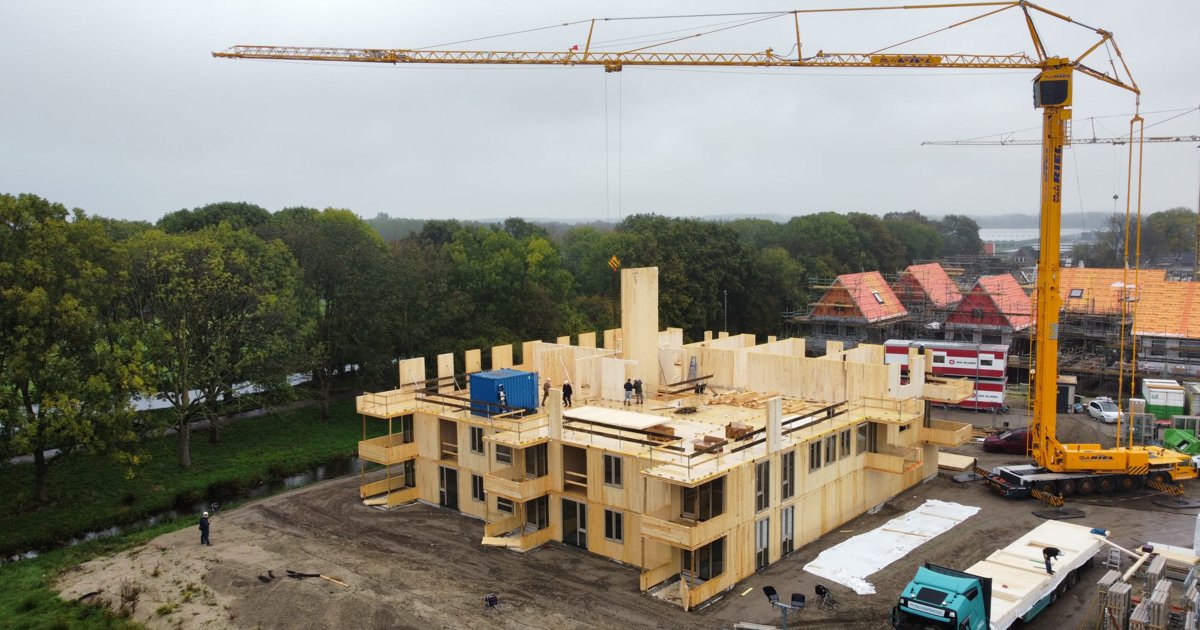
CLT architect for mass timber housing and urban development
Urban Climate Architects works as a CLT architect for housing, rooftop extensions, retrofit and low carbon urban development. We help local authorities, developers, housing associations and investors use Cross Laminated Timber in a way that is technically sound, architecturally strong and ready for delivery.
Our CLT expertise sits within the wider approach of a timber architect: we connect spatial quality, embodied carbon, circular architecture, prefabrication, fire strategy and construction logic from the earliest design stages.
Planning a CLT housing, extension or retrofit project?
Send us an email: info@ucarchitects.com
What does a CLT architect do?
A CLT architect translates the potential of Cross Laminated Timber into a building that is beautiful, practical and buildable. CLT is strong, lightweight and well suited to prefabrication, but it also requires careful thinking about spans, panel sizes, openings, connections, fire strategy, acoustic performance and installation.
A successful CLT project starts long before construction. The architect needs to understand how the timber is manufactured, transported, assembled, protected and potentially reused in the future.
Urban Climate Architects considers:
- structural logic and stability
- CLT panel sizes and prefabrication
- fire strategy and acoustic performance
- openings, services and coordination
- embodied carbon and whole-life impact
- circular detailing and future disassembly
- logistics and installation sequence
- spatial quality, daylight and user experience
This turns CLT from a technical product into the foundation for high-quality, low carbon architecture.
CLT as a Paris Proof building material
CLT supports lightweight, fast and climate-conscious buildings. Through its lower material impact, prefabricated construction method and long-term carbon storage in timber, CLT fits well within Paris Proof design. Read more about Paris Proof construction and the role of CLT.
Why CLT construction is growing
CLT construction is growing because clients need buildings that are faster to deliver, lower in carbon and more adaptable over time. Housing demand is high, carbon targets are becoming sharper and urban sites are increasingly constrained.
CLT responds well to these pressures. It is relatively lightweight, precise and suitable for dry, prefabricated assembly. This can reduce time on site, limit disruption and improve quality control.
CLT can support:
- lower embodied carbon
- carbon storage within the timber structure
- faster site assembly
- lighter construction for existing buildings
- reduced wet trades
- warm and tactile interiors
- circular and demountable design
For clients, this means greater speed, stronger environmental performance and a building that feels healthier and more human.
CLT for housing, rooftop extensions and retrofit
CLT can be used across many building types, but it is especially valuable where speed, weight and low carbon performance matter.
Housing
In housing, CLT supports repeatable layouts, high precision and efficient assembly. It works well for apartments, compact urban sites and projects where quality needs to be maintained across multiple homes.
Rooftop extensions
For rooftop extensions, weight is often the critical issue. Existing buildings cannot always carry heavy additional structures. CLT can offer a lighter solution for adding new homes or space above existing buildings.
Retrofit and transformation
In retrofit projects, CLT can be used for new floors, walls, extensions or additional storeys. This helps retain existing structures while giving buildings a new life.
Demountable and circular construction with CLT
CLT can support demountable and future-ready buildings. Through careful detailing, prefabricated elements and dry assembly, materials can retain value for longer. Read more about circular construction with timber and biobased materials.
What does CLT construction cost?
The cost of CLT construction depends on scale, spans, fire requirements, finish, acoustic performance, panel complexity, logistics and installation. A CLT project is more likely to perform well financially when the design is developed around the system from the beginning.
CLT may sometimes appear more expensive than conventional materials when viewed only as a product. However, the wider project case can be stronger when faster assembly, reduced disruption, lighter foundations and prefabrication are taken into account.
Key cost factors include:
- panel dimensions and grid logic
- structural spans
- prefabrication level
- openings and service routes
- fire-resistant build-ups
- acoustic requirements
- transport and crane strategy
- circular and demountable detailing
For a wider view of project feasibility, see our guide to the cost of timber construction.
CLT, circular architecture and embodied carbon
CLT can play an important role in circular architecture because it is biobased, stores carbon and can be designed for future reuse. Its real value depends on how the whole building is designed: connections, layers, materials, services and long-term adaptability all matter.
We design CLT buildings with attention to disassembly, material passports, reusable elements and long-term flexibility. This helps buildings remain useful as needs change.
CLT is also relevant for clients working towards net zero, low carbon design and whole-life carbon targets. By considering embodied carbon early, we can shape a project that performs better environmentally and remains aligned with future procurement and policy expectations.
CLT in practice
Urban CLT project
Challenge
The site requires a low carbon construction method with limited disruption, high precision and a clear delivery strategy.
Approach
CLT allows a lightweight, prefabricated structure. By considering logistics and assembly early, the project becomes more manageable on a constrained urban site.
Result
A future-ready building that shows how CLT can support low carbon urban development.
Groundbreaking CLT project in Delft.
CLT for rooftop extensions
Challenge
There is a need for additional homes, but existing structures often have limited load capacity.
Approach
CLT offers a lightweight system that can be assembled quickly and fits well with urban densification.
Result
New space above existing buildings, with less material use and reduced pressure on foundations and surroundings.
Optopping CLT project in Deventer.
CLT for public buildings
Challenge
Public buildings need to be healthy, robust, low carbon and inviting.
Approach
CLT combines structural strength with warmth, clarity and good internal atmosphere.
Result
A building that performs well technically while creating a calm, human and welcoming environment.
Low Carbon Mass Timber Construction in Rotterdam.
Would you like to know whether CLT is right for your project?
Give us a call: +31-88-2735411.
CLT or concrete: which works better?
The choice between CLT, concrete, steel or a hybrid system depends on the project’s priorities. CLT is often strong where low embodied carbon, speed, light weight and circularity matter. Concrete can still be appropriate for basements, certain acoustic conditions or specific structural requirements.
In many projects, the best answer is a hybrid one. CLT can be used where it adds most value, while other materials are applied where they are technically necessary.
See our guide to timber vs concrete for a clearer comparison of carbon, cost, construction time, weight and circular potential.
Working with a CLT architect
A good CLT project depends on early collaboration. The architect, structural engineer, services consultants, manufacturer, contractor and client need to work from shared assumptions. This helps avoid conflicts between design ambition, cost, fire strategy and delivery.
Urban Climate Architects supports clients with feasibility, concept design, mass timber strategy, material selection, procurement support and detailed coordination. We look at the building system, plan logic, façade, connections, circularity and climate-responsive design as one integrated whole.
For public projects and tenders, we also help translate CLT ambitions into clear selection criteria and project requirements. If you are preparing a circular or biobased brief, see how we work as a sustainable architect for procurement.


