
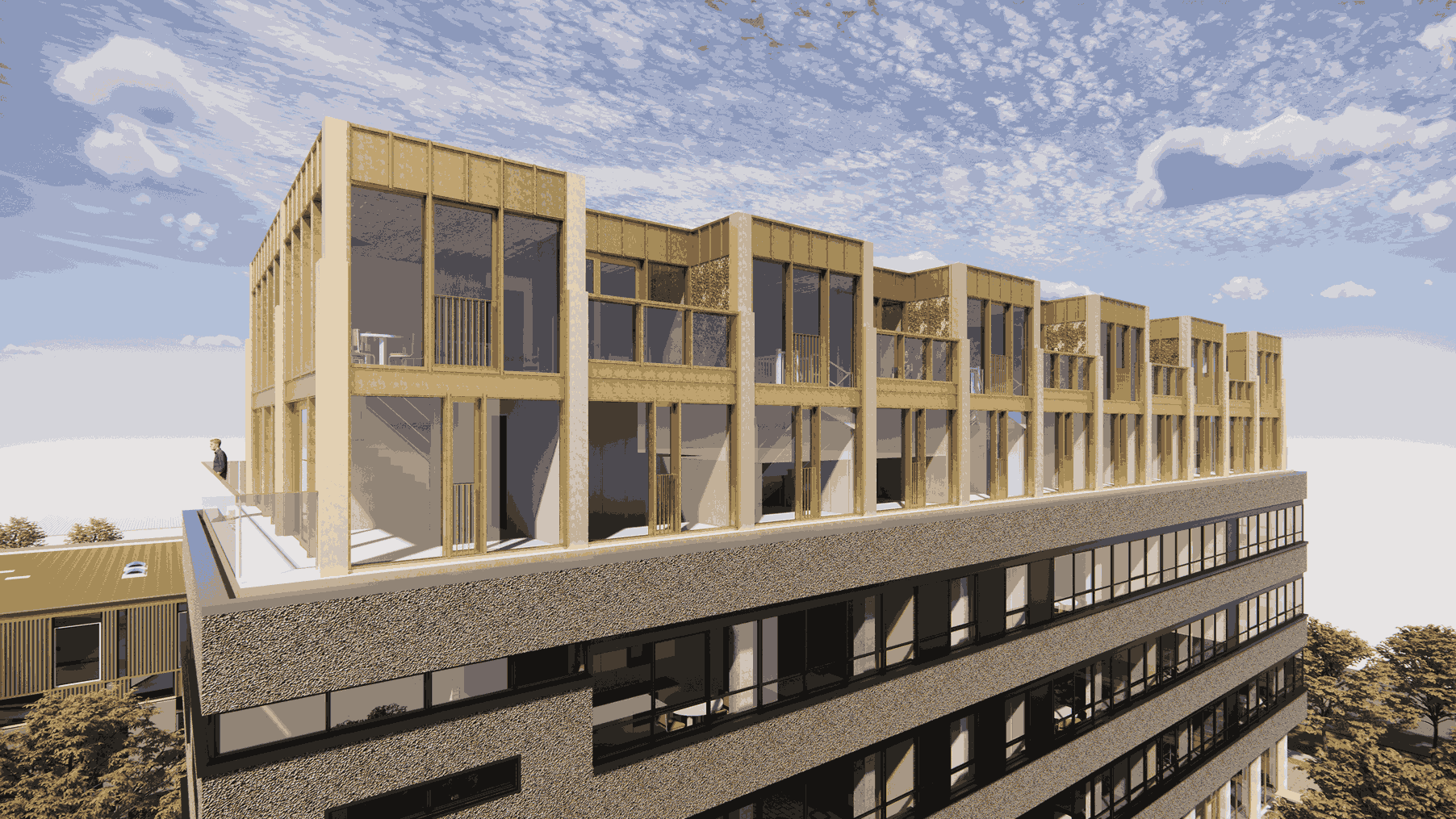
Vertical extension with timber construction for housing and urban densification
Vertical extension with timber construction is a smart way to add new homes to existing buildings, without using additional land. As a timber architect Urban Climate Architects helps municipalities, developers, housing corporations, and investors with researching, designing, and realizing lightweight, sustainable vertical extension projects.
By building on what's already there, we utilize existing foundations, infrastructure, and amenities. With CLT, solid timber construction, and bio-based materials, additional living space is created with less CO₂ impact, less demolition, and a shorter construction time.
Would you like to know if vertical extension is possible for your building or location?
Discover the possibilities for vertical extension with timber. Contact us: info@ucarchitects.com
What is vertical extension?
Vertical extension means that one or more floors are added to an existing building. Think of extra apartments on top of gallery flats, new residential floors on an office building, or a lightweight rooftop extension on social real estate.
The big advantage is that the city doesn't have to expand further. Vertical extension utilizes what's already there: existing buildings, streets, cables, pipes, public transport, and amenities. This makes it a powerful strategy for urban densification.
Timber construction plays an important role in this. Because wood is lighter than concrete, an additional floor can often be designed with less load on the existing structure. Especially CLT, Cross Laminated Timber, is interesting for vertical extensions. A specialized CLT architect Netherlands can assess early on how construction, fire safety, acoustics, and assembly come together.
Why vertical extension is currently relevant in the Netherlands
The Netherlands urgently needs more homes. At the same time, space is scarce, climate goals are under pressure, and municipalities want to make better use of existing neighborhoods. Vertical extension addresses precisely this challenge.
Instead of building in rural areas, vertical extension adds homes within existing cities and villages. This makes it attractive for housing corporations, municipalities, investors, and developers seeking feasible densification.
Vertical extension helps with:
- acceleration of housing construction
- better utilization of existing buildings
- less land use
- lower material impact than complete new construction
- preservation of existing urban structures
- increased demand for neighborhood amenities
- making existing buildings more sustainable
When vertical extensions are combined with timber construction, bio-based building, and circular design, a project approach emerges that adds value both spatially and ecologically.
Rooftop extensions and Paris Proof construction
Timber rooftop extensions make it possible to add new homes without additional land take. By using lightweight timber structures, material impact can be reduced while existing urban space is used more effectively. Read more about how rooftop extensions contribute to Paris Proof construction.
Vertical extensions with timber construction and CLT
Vertical extensions require light, precise, and smart construction. The existing foundation and load-bearing structure determine how much additional weight is possible, which is why timber construction is often a logical choice.
CLT and other mass timber constructions are relatively light, strong, and suitable for prefabrication. This means components can be precisely manufactured in advance and quickly assembled on site, limiting disruption for residents and the surrounding area.
At Urban Climate Architects, we consider from the outset:
- structural capacity of the existing building
- foundation and structural reinforcement
- fire safety
- acoustics and comfort
- daylight, views, and privacy
- building systems and access
- facade design and urban integration
- circularity, MPG, BENG, and embodied carbon
A rooftop extension project is never just a technical intervention. It changes the building, the street, and sometimes the entire neighborhood. That's why we combine structural logic with architectural quality and social integration.
What does adding extra floors cost?
The costs of adding extra floors vary greatly per building. The existing structure, foundation, installations, access, fire safety, building height, and permit requirements collectively determine feasibility.
Rooftop extensions with timber construction can be financially attractive because the structure is lightweight, can be prefabricated, and can be assembled relatively quickly. However, every project requires careful investigation. Sometimes additional stairwells, elevators, installations, or structural reinforcements are necessary.
Key cost factors include:
- structural analysis of the existing building
- foundation capacity
- number of additional floors
- choice for CLT, timber frame construction, or hybrid construction
- fire safety and acoustics
- utilities and access
- temporary facilities during construction
- permits and participation
For a more comprehensive financial assessment, we refer to the page about the costs of timber construction. There we explain how choices in design, materials, and execution impact total project costs.
Rooftop extensions versus new construction: less demolition, more city
Rooftop extensions are often more sustainable than complete demolition and new construction because the existing structure is utilized. This saves material, reduces waste, and preserves the value already present in the building.
However, rooftop extensions are not always automatically the best solution. Sometimes transformation, renovation, or new construction is more logical. The right choice depends on construction, living quality, energy performance, costs, regulations, and the desired lifespan.
That's why we always investigate rooftop extensions as part of a broader strategy for building transformation and urban densification. We assess the existing building's capacity, the potential spatial quality, and how the intervention contributes to the neighborhood.
Material selection also plays a significant role. In many projects, the comparison is timber construction vs. concrete relevant, especially when weight, CO₂ impact, construction time, and circularity are major considerations.
Who is adding storeys interesting for?
Adding storeys is particularly interesting for parties that own or develop existing buildings in areas where space is scarce.
For housing corporations adding storeys can help to add extra social or affordable housing within existing neighborhoods. At the same time, it offers opportunities to make existing complexes more sustainable.
For municipalities adding storeys is a strategy for accelerated housing construction, urban densification, and better utilization of existing infrastructure.
For developers and investors Adding storeys can add value to real estate, provided that feasibility is thoroughly investigated early on.
For social organizations Adding storeys can provide space for housing, care, education, or mixed-use functions in locations where ground-level expansion is not possible.
Urban Climate Architects assists these parties with feasibility studies, massing studies, design, participation, timber construction strategy, and tender preparation.
Rooftop extensions and circular construction
Rooftop extensions make use of existing buildings and avoid unnecessary land take. With timber construction, additional floors can be added in a lightweight, fast and material-conscious way. Read more about circular construction as a strategy for urban densification.
Adding storeys in practice
Adding storeys to existing residential buildings
Problem
There is a need for additional housing, but little space is available in the neighborhood.
Approach
By applying lightweight timber construction, additional floors can be added with limited load on the existing structure.
Result
More homes within the existing city, without developing new land.
Vertical extension with CLT in Deventer.
Transformation of existing real estate
Problem
An existing building no longer meets current requirements but still holds significant spatial and structural value.
Approach
By combining renovation, vertical extension, and bio-based materials, the building gains a new future.
Result
A future-proof building with increased utility value and reduced material waste.
Sustainable transformation in Groningen
Vertical extension with CLT
Problem
The existing structure can only bear limited additional weight.
Approach
CLT is used as a lightweight, prefabricated, and structurally efficient building system.
Result
A rapid and sustainable expansion with low CO₂ impact and minimal on-site disruption.
Project link
Place a link to a CLT project here.
Do you have a building where rooftop extensions seem promising?
Contact: +31-88-2735411
Rooftop extensions as a circular construction strategy
Rooftop extensions fit well within circular construction. Instead of demolition and starting anew, the existing city is used as a foundation. This saves materials, reduces waste, and extends the lifespan of buildings.
When rooftop extensions are combined with timber construction, a strong circular strategy emerges. Wood is biobased, relatively light, and can be detailed for disassembly. This ensures components remain more reusable in the future.
We see rooftop extensions as part of a broader movement towards:
- circular renovation
- reuse of building materials
- biobased construction
- urban densification
- climate-adaptive design
- nature-inclusive urban planning
- Paris Proof construction
This way, rooftop extensions are not just an extra floor, but an opportunity to make existing buildings, neighborhoods, and cities more future-proof.
From feasibility to tender
A rooftop extension project starts with good questions. What can the existing building support? How many homes are possible? Which regulations apply? What does the intervention mean for residents? And how does the project remain affordable?
Urban Climate Architects helps clients answer these questions early on. We translate spatial opportunities into a feasible design strategy, including timber construction, CLT, circular materialization, and construction logistics.
For public projects and tenders, we also assist with sustainable requests, selection criteria, and project ambitions. Are you working on a municipal or public assignment? Then we are happy to contribute as duurzame architect aanbesteding, zodat optoppen vanaf het begin goed wordt ingebed in proces, budget en ontwerpkwaliteit.


