
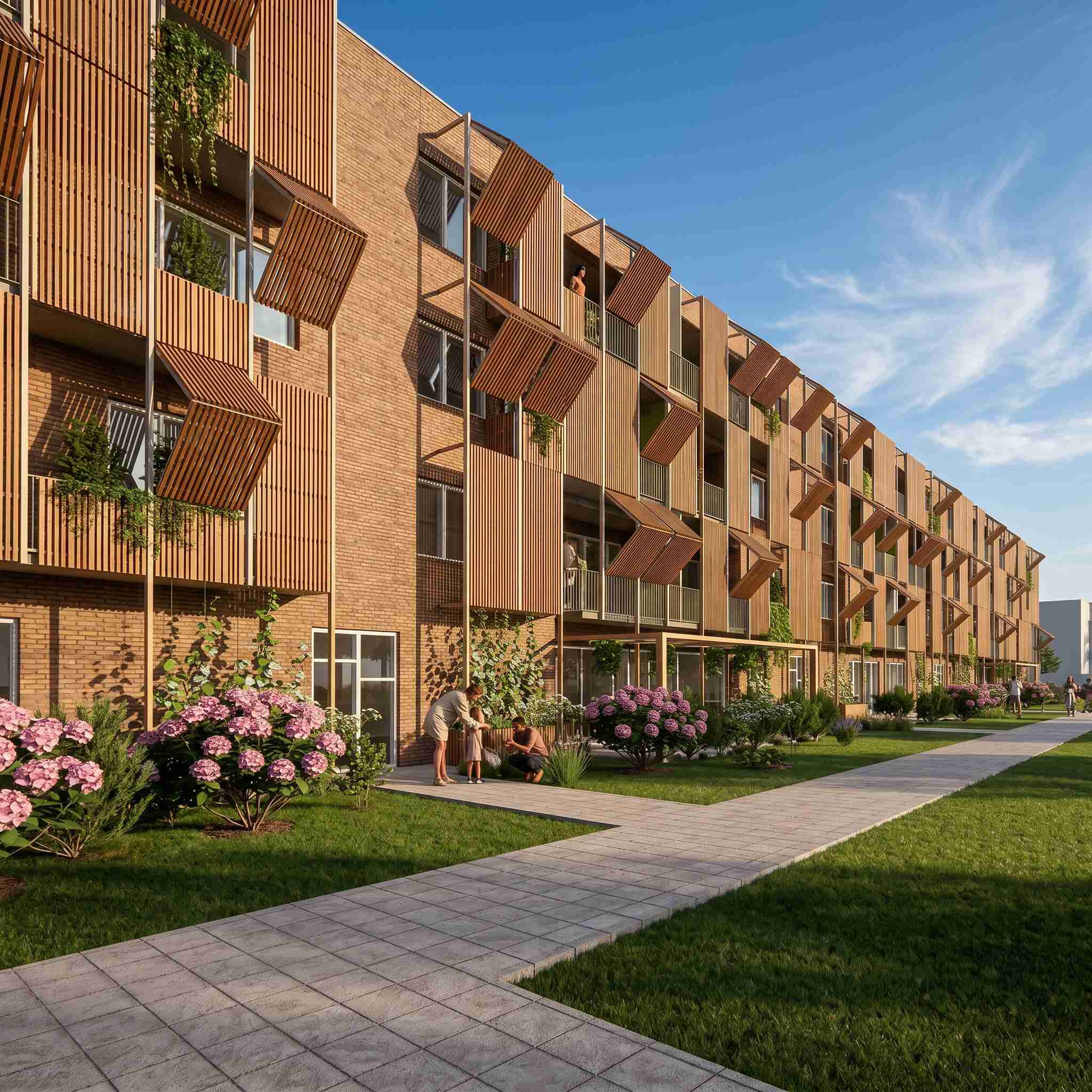
What is biobased construction?
Within this approach, a Mass timber architect a crucial role in translating ambitions into achievable projects.
Why biobased construction is becoming increasingly important
It contributes to:
- CO₂ reduction (Paris Proof construction)
- circular construction Netherlands
- healthier living environments
- faster construction processes with CLT Architect
The role of the biobased construction architect
At Urban Climate Architects, we work from an integrated vision where:
- timber construction and CLT structures are central
- design and engineering collaborate from the start
- circular strategies are incorporated
- urban densification is combined with sustainability
See how this approach is reflected in a sustainable architecture, where biobased construction is increasingly a decisive factor.
Biobased materials for Paris Proof buildings
Biobased construction is an important step towards buildings with lower carbon emissions. Materials such as timber, flax, hemp and cellulose fit well within a design strategy focused on low embodied carbon. Read more about our approach to Paris Proof construction.
Biobased construction and low-tech architecture
Biobased material choices are only half the story. The other half is the energy a building requires once it is in use. That is why, in every design, we critically assess the need for building services: which technologies genuinely add value, and which can be avoided by making the building itself perform better?
This approach starts with passive climate design. By designing intelligently around orientation, daylight, natural ventilation, solar shading and the thermal properties of materials, we reduce energy demand before adding technology.
From there, we move towards low-tech architecture: fewer installations, less material, lower maintenance and greater resilience. Wherever possible, we let the architecture itself do the work.
This is how we connect biobased building with low operational energy demand, creating healthy, comfortable buildings that perform sustainably from the outset.
Biobased construction and timber construction: the power of CLT
Mass timber construction, such as CLT (Cross Laminated Timber), makes biobased construction scalable.
Want to know more about this construction method? View our page on CLT architect Netherlands.
Financial considerations are also increasingly playing a role in sustainable area development. Therefore, read more about the costs of timber construction.
Biobased construction as part of system change
Biobased construction does not stand alone. It is part of a broader transition towards a sustainable built environment.
It relates to:
- circular construction and reuse of building materials
- building transformation architect strategies
- transformation of existing buildings
- nature-inclusive construction and biodiversity
- climate-adaptive design in cities
In combination with timber construction, a powerful solution emerges for urban densification and future-proof cities. Material choice also plays an important role in this. Therefore, also view our comparison Mass Timber vs Concrete.
The costs of biobased construction are highly dependent on scale, design, and material choice. In many cases, the investment costs are comparable to traditional construction, while the social and environmental benefits are significantly higher.
Read more about the financial aspects on our page about costs of timber construction.
Biobased construction vs traditional construction
For many clients, the comparison between materials plays an important role. Timber construction and biobased building offer clear advantages over concrete and steel, especially in terms of CO₂ and circularity.
Also view the detailed comparison Mass timber vs Concrete.
Biobased construction becomes stronger through circularity
Biobased materials gain more value when they are applied in demountable, reusable and future-ready ways. This is where biobased construction and circularity reinforce one another. Read more about circular construction.
Collaborating on biobased projects
Biobased construction requires a different way of collaborating. Early integration of design, engineering, and execution is essential.
We are increasingly guiding projects within a sustainable architect tender, where biobased construction plays a central role.
Additionally, we regularly work on integrated projects where the expertise of a Mass Timber Architect combined with circular construction, urban densification, and climate-adaptive design.


